

On the World Heritage Trail from Krems to Dürnstein
By Reinhard Mandl*
With its picturesque terraced vineyards, dry-stone walls, and well-preserved villages, the Wachau is a true work of art. I travel from Vienna Heiligenstadt via Absdorf-Hippersdorf on the “Kremser Ast” branch of the Franz-Josefs-Bahn without changing trains to Krems, the starting point of the Wachau World Heritage Trail. The first stage of this long-distance hiking trail takes me to Dürnstein. I return by local bus first to the Krems train station and then continue by train to Vienna.
From Krems Train Station through the Old Town
Krems Train Station is located just a short distance from Untere Landstraße, the central pedestrian zone in Krems’s picturesque Old Town. Without further ado, I head up to the Hoher Markt, the starting point of the Wachau World Heritage Trail. Although the first stage to Dürnstein is only just under 13 kilometers long, a walking time of four and a half hours is estimated for this route, as a total of 548 meters of elevation gain must be conquered.
Piaristengasse leads me to the church of the same name. Its tower is the only church tower in Austria that does not bear a cross at its top, but rather the coat of arms of the city of Krems. I walk down Frauenberggasse and immediately back up the Kreuzbergstiege. Again and again, I stop and look back at the impressive rooftops, dominated by the “Cathedral of the Wachau,” the Krems City Parish Church.
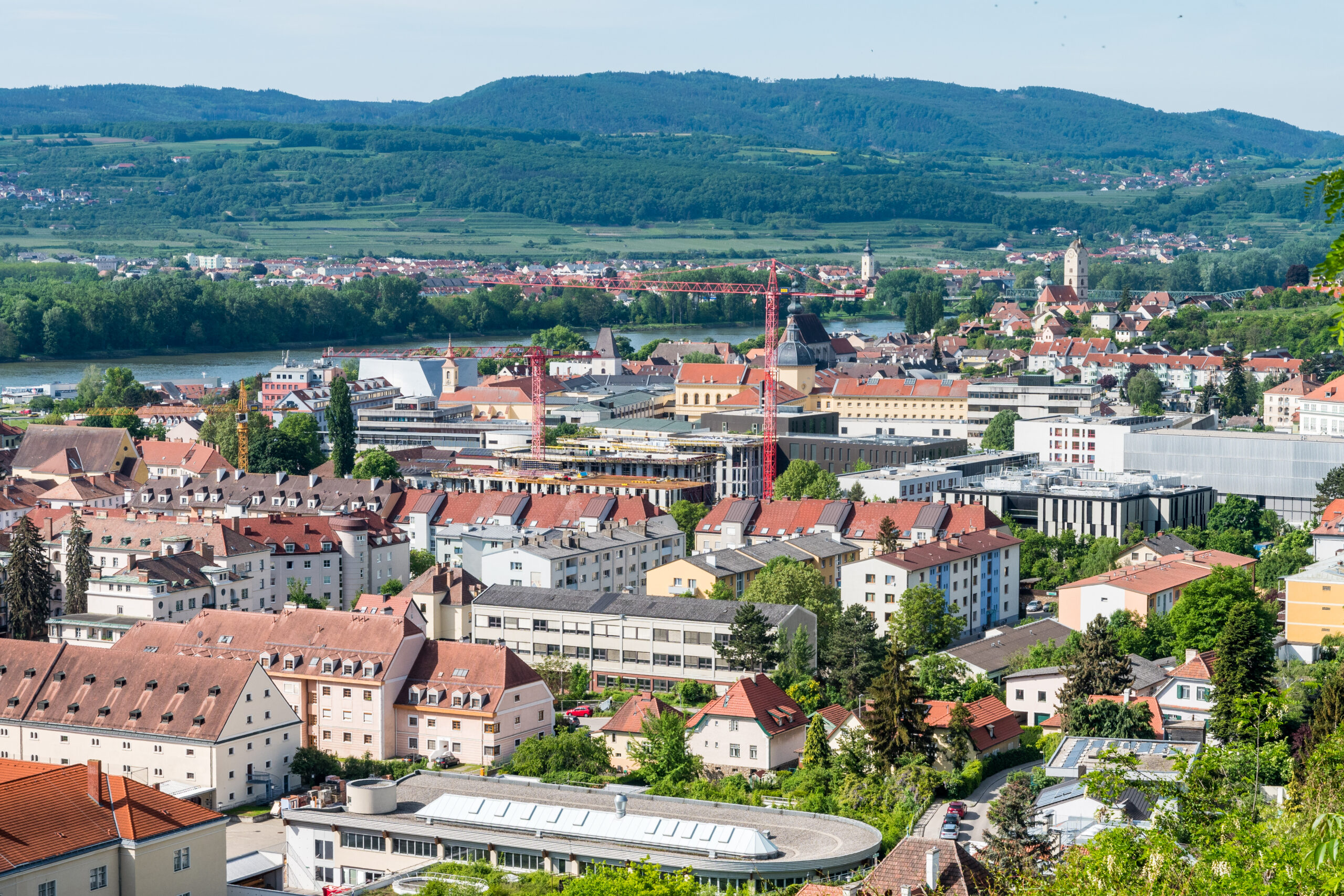
Soon I reach Stein, which was a town in its own right until 1938. Today’s Krems district of Stein is home to Danube University and the Krems Art Mile, where several prominent museums are lined up side by side. I had already spotted the silvery-shimmering shell of the new Lower Austria State Gallery from the Kreuzberg.
From the Steiner Kellergasse, it is not far to the Frauenberg Church, which stands on an ancient settlement site. In the 1960s, the church was converted into a war memorial.


Views of the Danube and terraced vineyards
Next to the tunnel exit of the Wachau Railway on the outskirts of Stein, I descend a steep flight of stairs and immediately climb an even steeper one. Far below me, I can now see the iron Danube Bridge between Krems and Mautern, and behind it, on the horizon, stands the Benedictine Abbey of Göttweig. From the lookout point near the Ried Pfaffenberg, I look out over the wooded slopes of the Dunkelsteiner Forest on the opposite bank of the Danube.
On the left side of the river, right at my feet, I look out over vineyards near Unterloiben, bordered by the Wachaubahn railway line. Until the construction of the federal highway in the late 1950s, the railroad was the most important mode of transportation on the left bank of the Danube. Its contribution to the region’s development as a tourist destination cannot be overstated. It is a shame that the historic Wachau Railway is now used only seasonally for nostalgic rides.
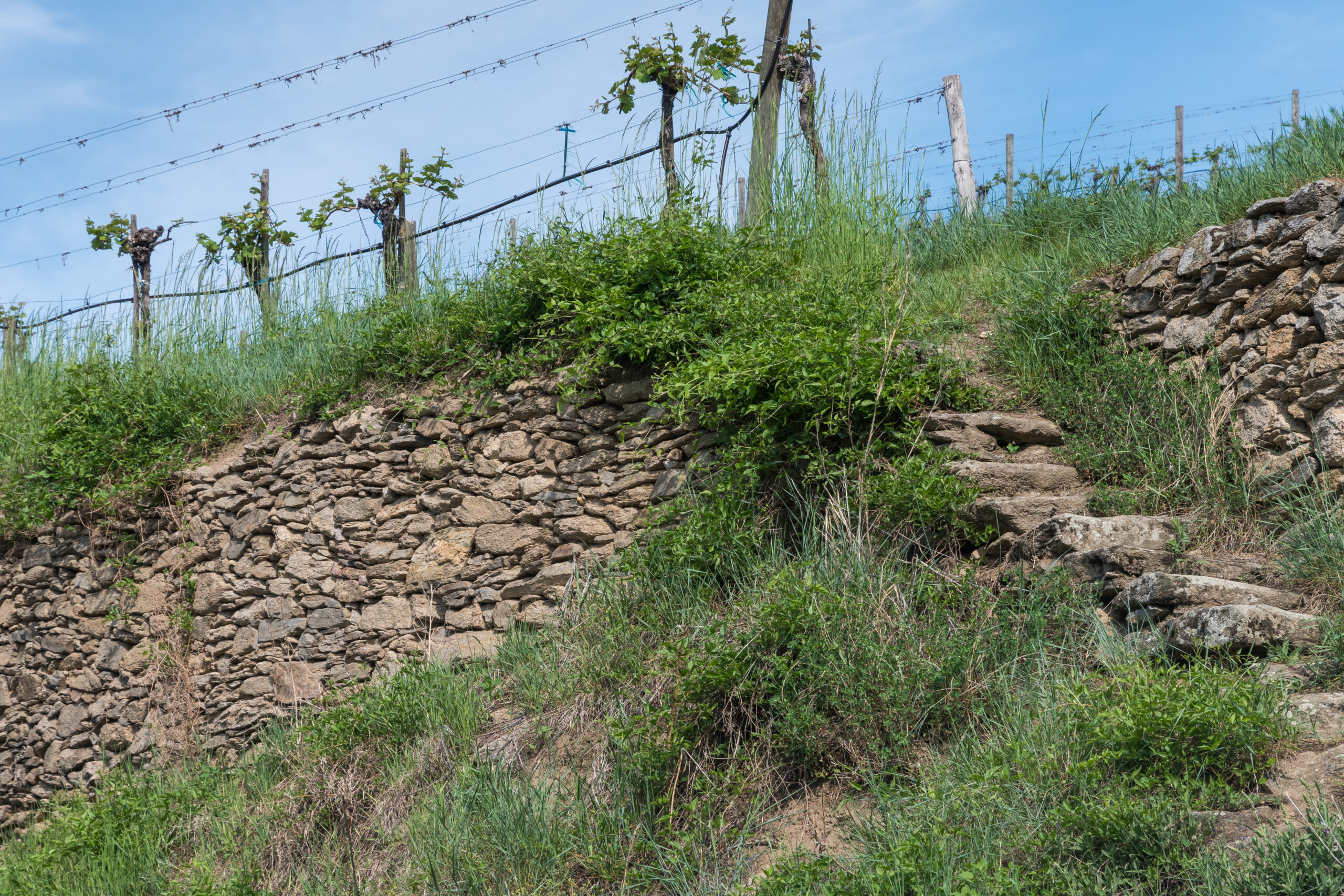
The Wachau Railway winds its way through picturesque terraced vineyards, which make up nearly half of the Wachau’s vineyard area. In particularly steep locations, this type of viticulture is the only viable option. Terraced vineyards owe their existence to dry stone walls. Some were rebuilt only recently, while others date back to the 19th or even the 18th century and remain sturdy to this day.
The knowledge and, above all, the experience required to build them are passed down from one generation of winegrowers to the next. These water-permeable dry stone walls are a hallmark of the Wachau region and, moreover, a valuable habitat for many animal species, such as the rare green lizard.
Höhereck, Wachau Wine View & Dürnstein Castle Ruins – Highlights of the Wachau World Heritage Trail
The next ridge along my route is called Höhereck and is a protected area due to the dry grassland species found here. In the distance, I can make out the French War Memorial near Loiben, which commemorates the Battle of Dürnstein in 1805.
From the “Wachauer Weinblick,” I look out over the vineyards of the “Domäne Wachau” cooperative to the south, and to the west, the ruins of Dürnstein Castle come into view more and more clearly. Right next to it, I see people dressed in colorful gear hanging from the gneiss cliffs at the Dürnstein climbing garden.
The climb up to the castle ruins is steep enough for me. Within the inhospitable walls of this rock fortress, the English King Richard the Lionheart was held captive in 1192/93 and released only after an astronomically high ransom was paid.
I climb higher and higher, looking down at the Danube as it elegantly curves westward. Back toward the east, my gaze wanders over the “Däumling” in the climbing garden toward Göttweig Abbey.


Descent via the Eselweg & Wachau Specialties
On my way down from the castle ruins to the village, I choose the shorter but more challenging donkey trail. The few houses in Dürnstein are nestled together in an incredibly compact cluster. Suddenly, I find myself on the main street, through which a seemingly endless stream of people is flowing.
At the Schmidl bakery, I buy one of the famous “Wachauer Laberl,” which have been made here for centuries. Under the Clemens-Holzmeister lime tree in front of the former Poor Clares convent, I find a quiet spot to sample my “Laberl.” The pastry is beautifully crispy on the outside, fluffy on the inside, and tastes exquisite. In the shaded outdoor seating area of the “Sänger Blondel” inn, I move on to the second part of my culinary discovery tour of the Wachau. I order a serving of apricot dumplings and a glass of Grüner Veltliner to go with it.
Discover Dürnstein Abbey: Museum and a view of the famous blue church tower
My next stop takes me to Dürnstein Abbey, where monks have not lived for a long time. This Baroque gem is now owned by the Augustinian Canons’ Abbey of Herzogenburg, which has been operating a museum here since 2019 in collaboration with the state of Lower Austria.
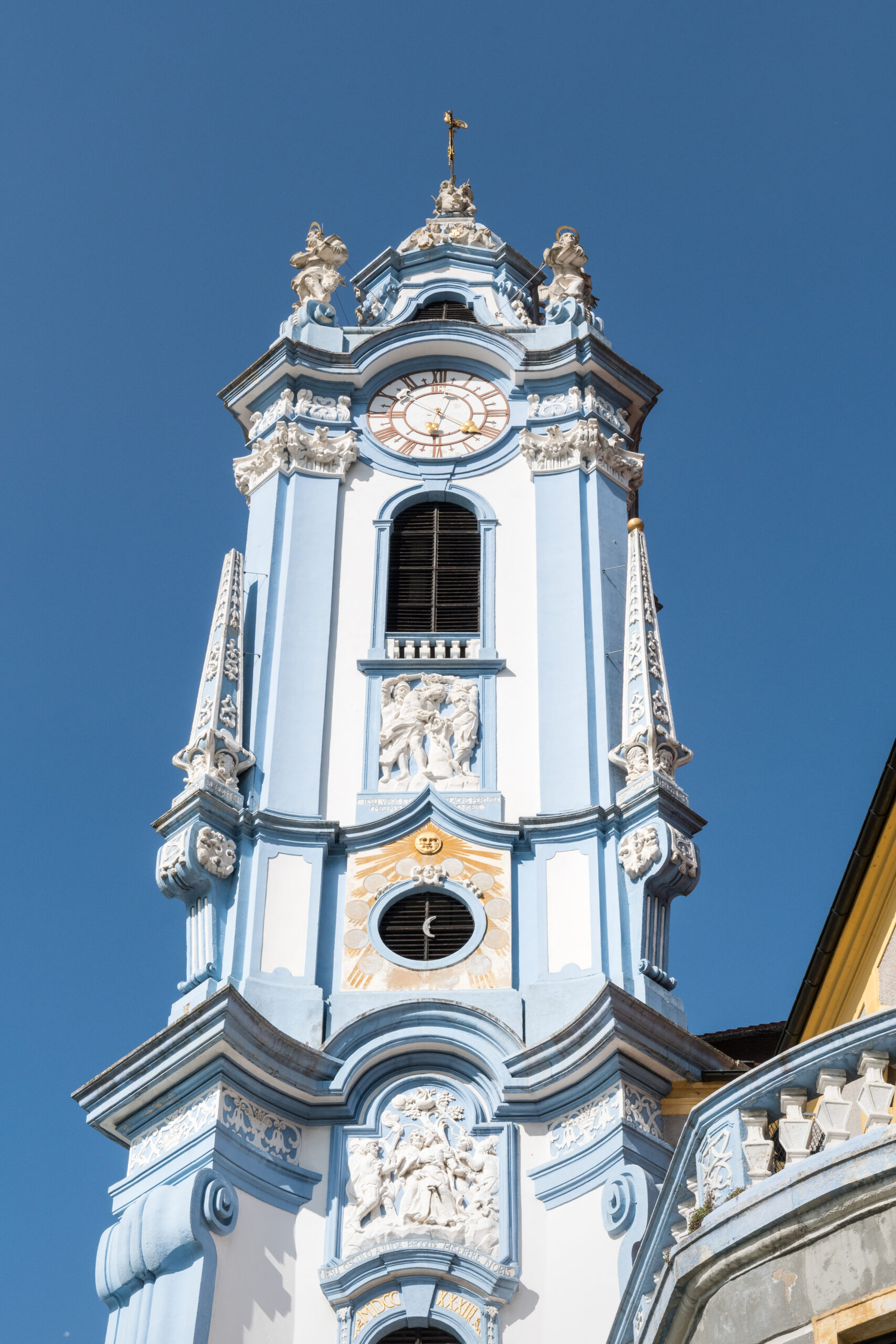
I tour the permanent exhibition, which also leads me to the abbey’s Danube terrace. Here I can view one of the Wachau’s most famous landmarks up close: the tower of the abbey church, which has been shining in its original shades of blue and white again since the 1980s. Directly below the terrace runs the Danube promenade, bustling with walkers and cyclists.
One of the most tranquil spots on the promenade is the Malerwinkel. It serves as a reminder that it was the artists who, through their paintings, made the Wachau a popular destination of longing. I walk along the promenade to the bus parking lot. With a touch of wistfulness, I board the No. 715 bus, which runs hourly back to the Krems train station—I would much rather have taken the Wachau Railway.


* This text is an abridged version by the author of Chapter 11 of his book Discover Austria with the Klimaticket: 20 Trips by Bus and Train.